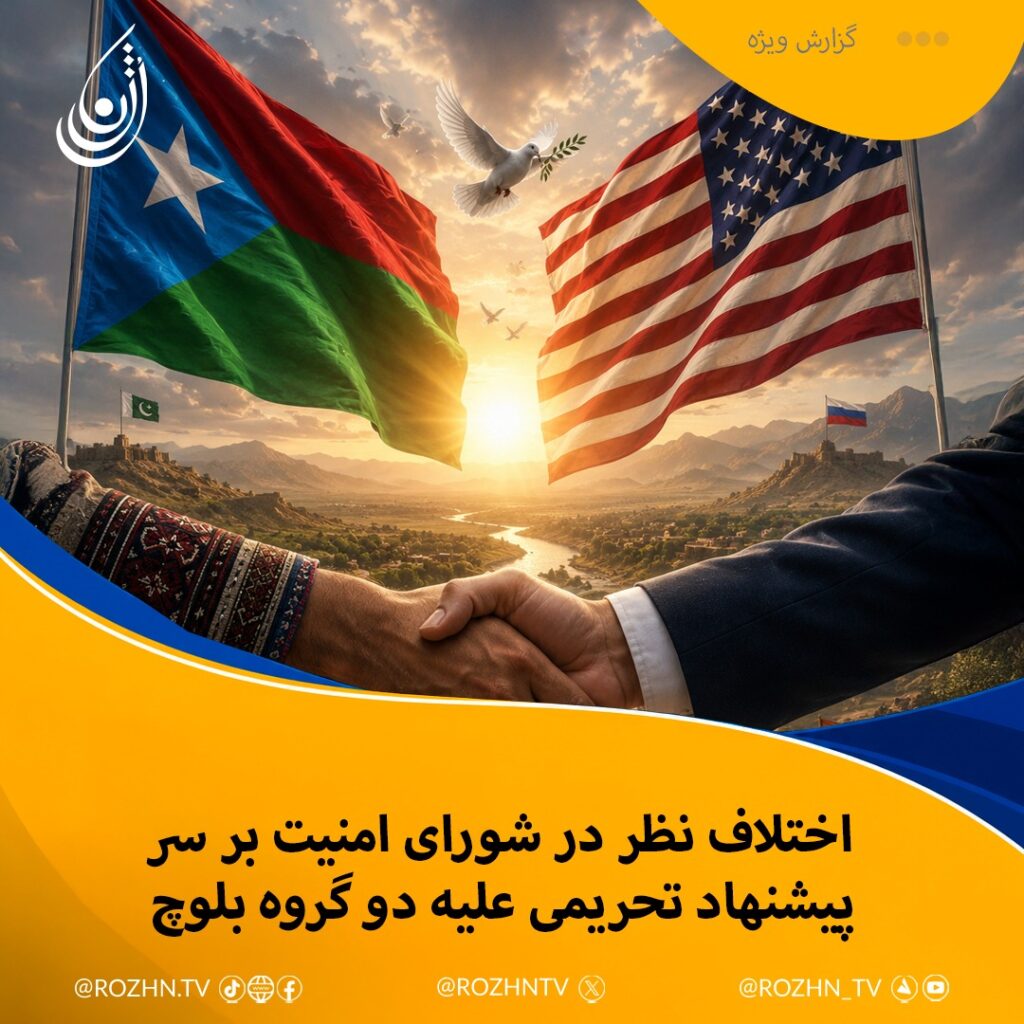
US Opposes Chinese and Pakistani Proposal to Put Two Baloch Groups on UN Sanctions List
According to international media reports, the United States has opposed a joint Pakistani and Chinese proposal to place the “Balochistan Liberation Army” and the “Majeed Brigade” on the sanctions list of the UN Security Council’s …
Rozhn TV | Monday, June 8, 2026
According to international media reports, the United States has opposed a joint Pakistani and Chinese proposal to place the “Balochistan Liberation Army” and the “Majeed Brigade” on the sanctions list of the UN Security Council’s 1267 Committee.
Reports say that in reviewing the case, Washington stated that for a group to fall under the 1267 Committee sanctions, there must be a specific link to the al-Qaeda network or the group known as the “Islamic State”. According to diplomatic sources cited in various media outlets, the United States stated that sufficient evidence to prove such a link had not been presented for the two groups.
According to these reports, Pakistan and China, after months of lobbying at the United Nations, had tried to have the names of the two groups entered on the sanctions list related to al-Qaeda and the Islamic State. However, the review process was halted by US opposition, and the proposal ultimately came to nothing.
Some Indian media outlets have reported that India and France also supported the US position during the review of the case. It has also been reported that the United Kingdom went along with this view. By contrast, China and Pakistan were the main backers of the proposal.
The UN Security Council’s 1267 Committee was established specifically to impose sanctions on individuals and groups linked to al-Qaeda and the Islamic State. International law experts believe that being placed on this list requires specific legal and security criteria, which are examined by members of the Security Council.
As of this report, the United Nations has not issued an independent statement on the details of the recent decision. Pakistani and Chinese officials have also not offered any new official reaction on the matter.
Political observers view the decision as part of existing disagreements among world powers over how to use the UN’s sanctions mechanisms. However, the decision does not mean a change in the legal or political status of other cases related to regional security, and relates solely to the legal framework of the 1267 Committee.