BalochistanLong read
Tis Fort: A Long Narrative of History, Power and Seafaring on the Makran Coast
A historical and cultural report on Tis Fort near Chabahar, tracing the ancient port's trade links, its rulers, the Portuguese name and the Baloch coastal heritage, while noting open questions about dating.
Rozhn TV | Thursday, November 26, 2026
Special historical and cultural report: from the ancient port of Tis to the heritage of Balochistan today
Introduction: a fort whose story begins at the sea
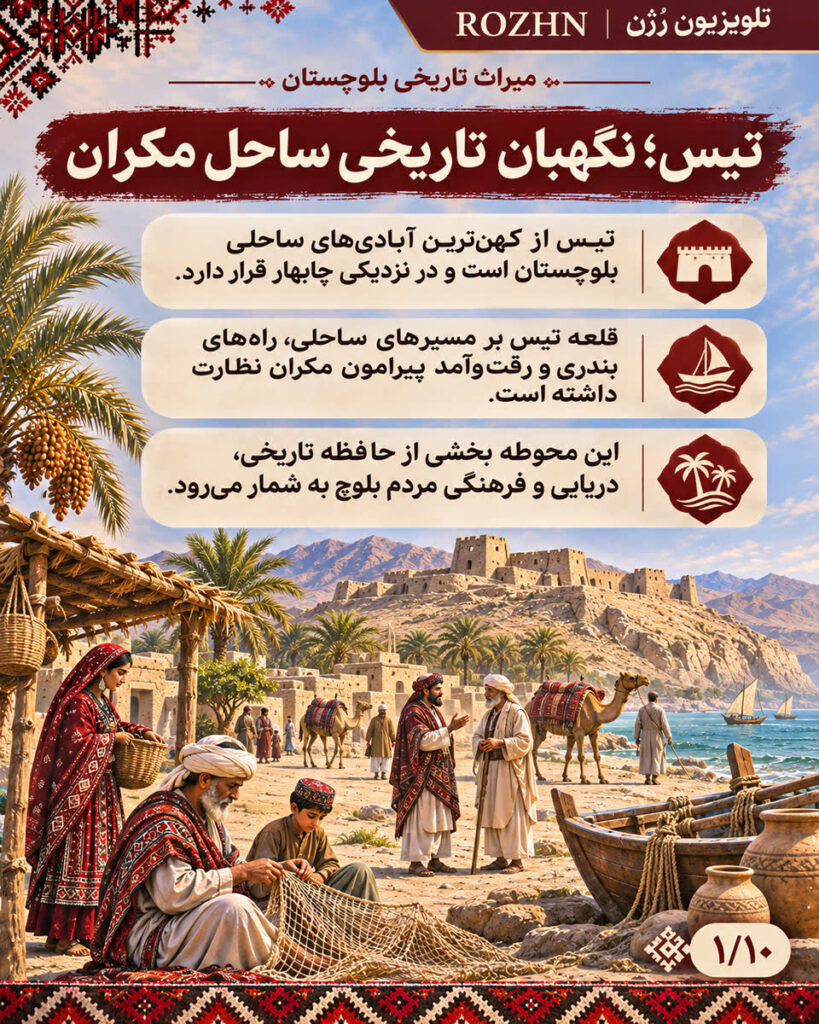
In the northwest of Chabahar, near the waters of the Sea of Oman and along the historic coast of Makran, lie the remains of a fort that locals know as “Tis Fort” and “the Portuguese Fort.”
The worn walls, half-ruined towers and remains of stone buildings of this fort are relics of a time when the port of Tis held an important place in the region’s maritime traffic and economic links. But the history of Tis is not merely the history of a fort.
Over many centuries this area has been a meeting point of sea and land, of merchants and seafarers, of rulers and ordinary people. Here ships reached the shore by sea, goods moved between ports and inland settlements, and various powers competed to control trade routes.
To understand the history of Balochistan, one must look beyond the walls of the fort and pay attention to the lives of the people who lived around it. Tis should be regarded as part of the maritime and cultural history of Balochistan, a history that began long before the arrival of the Portuguese and has continued to this day.
1. Geographical location: why did Tis matter? Artistic illustration: Where is Tis?
The historic Tis Fort is in the village of Tis, about five kilometers northwest of Chabahar. According to heritage descriptions, the fort stands on a rise near the coast, and its distance from the sea is reported to be about five hundred meters.
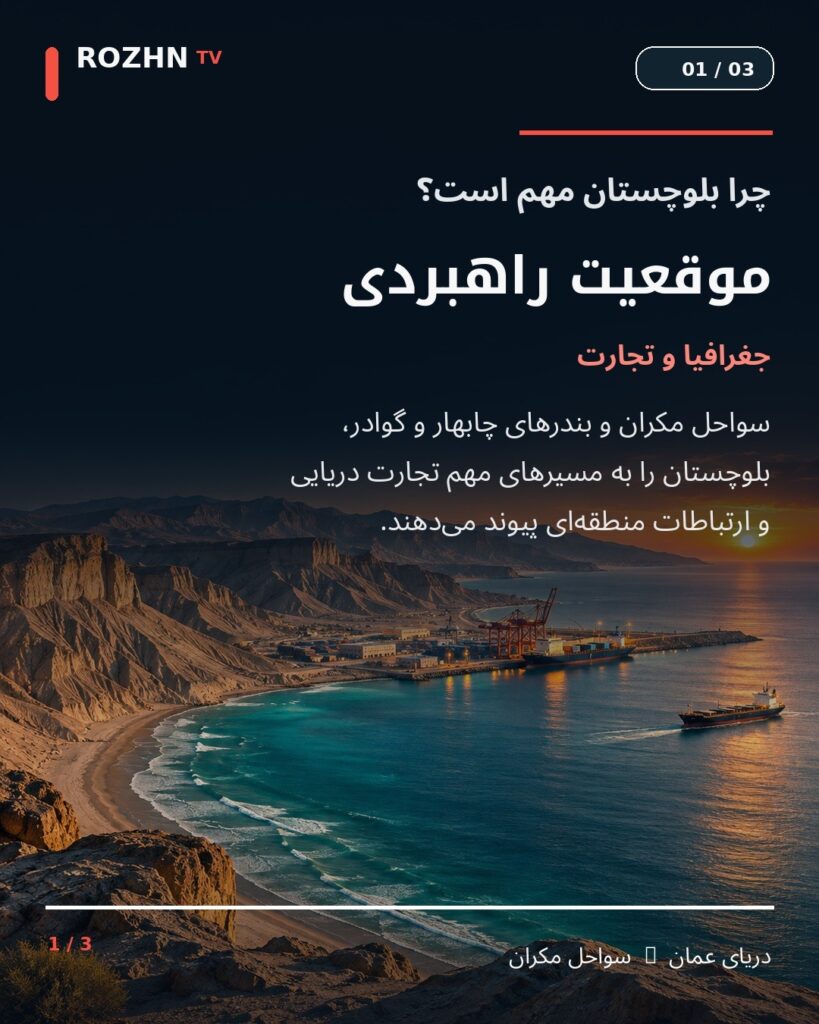
The first factor behind Tis’s importance was its proximity to the Sea of Oman and to maritime routes. Ships travelling between the coasts of Makran, Oman, the Persian Gulf and the Indian subcontinent needed ports and safe places to stop, trade and resupply.
Second was Tis’s link with the inland settlements of Balochistan. Goods arriving by sea could be carried by land routes to other parts of Makran. In the opposite direction, products and goods from inland areas moved toward the coast.
Third was the presence of coastal heights. Fortifications built on such rises made it possible to observe parts of the routes near the port and to watch over its surroundings. Tis’s importance therefore did not lie only in its military position; the port was part of the region’s communication and economic structure.
2. Tis before the Portuguese: a port with a long past Artistic illustration: Tis, the ancient port of Makran
One of the most important mistakes in narrating the history of Tis is to begin the region’s past only with the Portuguese presence. Historical and archaeological evidence indicates that the port of Tis was part of the Indian Ocean trade network before European naval power expanded in the region.
In an academic study titled “An Introduction to the Culture of Tis Based on Surveys and Studies of Islamic-Period Archaeology,” published in 2025, researchers examined Tis’s economic links and their effect on the formation of coastal and inland settlements in Makran.
In this study, glazed pottery of the Islamic period and Chinese celadon ware are presented as important evidence of the region’s wide commercial links. These finds show that Tis did not depend only on nearby markets but was also connected to distant trade networks.
Of course, finding a Chinese vessel does not necessarily mean that a Chinese ship entered that port directly; goods could reach their destination through several ports, merchants and intermediaries. The finds at Tis present a picture of a wide network of maritime and overland exchange.
3. Seafarers, merchants and the Baloch coastal people Artistic illustration: people and daily life
The history of ports is not written only with the names of kings and rulers. Behind every historic port lies the life of diverse groups of people. To understand the social history of Tis, one must also examine the role of fishermen, seafarers, merchants, port workers, craftsmen, farmers and the families living in the area.
Fishing has been one of the important and long-standing activities of Makran’s coastal communities. For those working with boats and ships, knowledge of currents, the right fishing seasons, wind directions and sea conditions was vital.
Maritime trade required skills such as maintaining and repairing vessels, moving cargo, storing food and supplying water. Port markets could be meeting places for people from different regions, who brought with them different languages, goods and experiences.
Attention to traditional Baloch clothing, handicrafts, food, music and the oral narratives of local people can reveal the human dimensions of this history, though independent research is needed to attribute any specific tradition to a particular historical period. The real strength of a port lay not only in its walls and towers but in the knowledge, labor and experience of the people who had tied their lives to the sea.
4. Tis’s heyday: from ancient routes to the Seljuk era
One of the important periods in the history of Tis was the fifth and sixth centuries AH, equivalent to the eleventh and twelfth centuries CE. Recent research indicates that in this period, particularly under the Seljuks of Kerman, Tis was considered one of the important ports of the Makran coast.
The Seljuks of Kerman held political influence in parts of the southeast of the Iranian plateau, and the port of Tis was administered within the governmental and economic structure of that era. The port’s prosperity helped expand commercial links and fostered the formation or growth of surrounding settlements.
When Tis’s economic importance declined, some related settlements and sites also fell into stagnation. A port was not merely a stopping place for ships; a thriving port could also affect the lives of farmers, producers, goods carriers and residents of more distant villages.
One important question is how much of this trade network was in the hands of local merchants and families, and which parts were run under the supervision of regional powers. An answer could give a more accurate picture of the role of the people of Makran in the economy of that era.
5. The architecture of Tis Fort: stone, tower and lookout Artistic illustration: the architecture of Tis Fort
The fort seen today at Tis has architectural features that researchers have compared with various periods of Islamic history. According to information recorded in the historical heritage register, the structure is reported to measure about 54 by 26 meters, and stone, brick and gypsum plaster were used in its construction.
In descriptions of its historical structure, four towers at the corners, a central courtyard and rooms around the courtyard are mentioned. There are also the remains of a minaret, reported to be about 5.6 meters high, which was used to watch over the Bay of Tis.
The towers made it possible to watch over the surroundings of the fortifications and detect nearby movements. In coastal forts, watching from the sea side was also important. The central courtyard and the rooms around it show that the structure was not merely a single isolated tower, but determining the exact use of each space requires specialist study.
Descriptive reports of the fort mention traces of cisterns at the corners of the courtyard. In Makran’s arid climate, wells and water storage tanks were of great importance, especially when access to outside sources was difficult.
In some sources, the features of the towers and parts of the rooms are attributed to Seljuk architectural style, and repairs and decorations from the Safavid and Qajar periods are also mentioned. Therefore, not all parts of the fort can be assigned to a single period without sufficient evidence.
Artistic illustration: water and palm groves in Tis 6. Why is Tis Fort called “the Portuguese Fort”? Artistic illustration: why “the Portuguese Fort”?
In many tourism writings, Tis Fort is introduced under the Portuguese name. This name may give the impression that the entire present building was built by Portuguese forces, but historical evidence does not readily support such a conclusion.
In the sixteenth century CE, Portugal sought to control maritime trade routes in the Indian Ocean and the Persian Gulf. According to Encyclopaedia Iranica, a Portuguese naval force attacked the historic port of Tiz in 1581 CE and destroyed it.
This event shows that the port of Tiz was still politically and strategically significant during the expansion of Portuguese naval power. However, the date of the 1581 attack should not be taken as the same as the construction date of the present fort.
The same source also mentions the construction of a fortification on a hilltop at the mouth of a valley in the nineteenth century. For dating, one must distinguish between the history of the ancient port of Tis, Portuguese activities in the region, and the construction and restoration phases of the various parts of the current structure. The name “the Portuguese Fort” is part of the building’s fame today, but it is not enough to understand its history.
7. Baloch rulers and the rivalry for control of Tis Artistic illustration: Tis in political developments
One important part of Tis’s political history is the role of local powers in controlling the port and its relationship with larger states. From various periods of Makran’s history, accounts remain about local rulers, Baloch families, military forces and rivalry over coastal ports.
In the historical research published in the “Man and the Sea” collection of the National Museum of Iran, events concerning the port of Tis and its rulers have been compiled. According to one account, in the time of Nader Shah Afshar, Pirmohammad Khan, after capturing Tis, appointed Amir Dinar Makrani as its ruler.
This report shows that Tis held a place in the developments of the Afsharid period and that the name of a local Makrani figure was recorded in the administration of the port. However, further documents are needed on the length of Amir Dinar’s rule and the exact extent of his domain.
Another figure in the history of Tis is Mohammad Ebrahim Khan Sa’ad al-Dawla Baloch. According to the account cited in the “Man and the Sea” collection, in 1863 CE, equivalent to 1280 AH, he built a large tower in Tis, which was destroyed the same year by Dinmohammad Khan Jadgal.
The construction and destruction of a tower may be a sign of rivalry over control of the region, but from this report alone no definitive judgment can be made about the exact motives of the parties involved or the long-term political outcome.
In the nineteenth century CE, the Chabahar region and its surroundings were part of a complex political arena in which local rulers, the Sultanate of Oman, the Qajar government and British power held different interests and claims. Encyclopaedia Iranica reports that Chabahar was under Omani administration for a considerable part of that period, and that in 1872 CE, forces of Ebrahim Khan under the command of Hossein Khan Geh took control of the town. The history of Chabahar should not be generalized to all parts of Tis without examination.
8. The Qajar period: construction of the fort and renewed attention to the port of Tis
In the second half of the nineteenth century CE, Tis appears once again in documents on the politics and administration of the Makran coast. One important report remains from Mirza Mehdi Khan Sartip Ghaeni.
According to this account, Vakil al-Molk, the governor of Kerman, after learning of the conditions of the port of Tis, acted to examine and develop it. In this period a small fort was built to consolidate the government’s presence, and about twenty families from Dasht were settled in the area.
The historical report speaks of new buildings, the existence of water wells and the suitability of the port’s location. This information shows that in the nineteenth century Tis was not merely an abandoned site, but that efforts were made to revive its port and administrative function.
Over time, the economic role of Tis changed. The evolution of trade networks, the shifting importance of neighboring ports and changing political conditions are among the factors that must be examined to explain the historical decline of Tis. Archaeological research has also observed a link between the decline of Tis’s commercial standing and the stagnation of some settlements in the region.
9. The historical link between Tis and Bampur, Qasr-e Qand and other centers of Balochistan
To properly understand the history of Tis, this port should not be separated from other parts of Balochistan. Throughout history, Makran has had a network of coastal and inland centers.
Bampur, Pahra, Qasr-e Qand, Nikshahr and other settlements of the region played different roles in politics, agriculture, trade and overland communication in different periods. Tis from the sea side and the inland centers via land routes could be placed within this same broad network.
Bampur Fort is one of the important centers of power and historical settlement in Balochistan. Qasr-e Qand Fort is important for studying local rule and communication routes. Naseri Fort in Pahra is also an example of Qajar-era administrative and military fortifications.
Studying these centers together can answer important questions: How did goods from inland areas reach the coast? Who protected the roads? How were trade duties collected? And what relationship did coastal rulers have with inland powers?
10. Historic sites around Tis: beyond a single fort Artistic illustration: historic sites around Tis
The Tis region has more than just a fort. The sites and historic remains around it offer a broader picture of the life and culture of the region’s inhabitants.
The Ban Masiti caves are among the best-known historic sites around Tis. This complex includes rock-cut, hand-dug spaces and is important for studying rock architecture, the historical use of the natural environment and local traditions. The use and exact dating of its various parts must be determined through specialist research.
The historic cemetery of Tis, sometimes also called the “Graveyard of the Jinn,” is linked with folk narratives and beliefs. For historical research, a distinction must be made between local legends and archaeological evidence.
The historic mosque of Tis, the remains of old structures in the village and other surrounding sites are also parts of the cultural landscape of this area. Tis should be studied as a set comprising the port, the fort, ancient sites, communication routes and traces of human life.
11. The decline of the port and the continuity of people’s lives
With the decline of the historical standing of the port of Tis, the life of the people of the region did not end entirely. Settlement in the area continued, and activities such as fishing and other local occupations remained part of people’s livelihoods.
Meanwhile, Chabahar gradually gained a more important place in the region’s port network. Periods of declining prosperity, population change and the shifting of economic activity are also part of history.
To document these periods, the oral accounts of old families of Tis are important, including memories of the port, ships, economic activities, construction and the changing face of the village. These accounts must be compared with documents and historical evidence to prevent memory and legend from being turned into established fact.
12. Baloch cultural heritage and the importance of preserving Tis Fort Artistic illustration: protecting Tis’s heritage
Tis Fort today is not merely a stone structure but a sign of the long history of the Baloch people’s relationship with the sea. Preserving it could provide an opportunity to present Makran’s seafaring history, traditions of coastal trade, vernacular architecture, the role of local rulers and the life of the region’s families.
Documenting the remains of the fort, examining the state of erosion, collecting documents on the history of Tis, recording oral accounts and presenting this heritage in Balochi and Persian are among the measures that help preserve and understand it.
Preserving historic monuments is not achieved only by rebuilding walls. Recording the names of places, local words, family stories, maritime traditions and the experiences of past generations also plays a role in safeguarding cultural heritage.
13. Questions that the history of Tis has yet to fully answer
Despite the historical information and archaeological research, many questions remain about this port. One of the most important is the exact construction date of the various parts of the present fort.
Another question concerns the nature of the Portuguese presence: for how long and on what scale were they active in Tis, and what independent evidence exists of their presence at the fort site itself?
About Amir Dinar Makrani, Mohammad Ebrahim Khan Baloch and Dinmohammad Khan Jadgal, too, further documents can be sought. Research on caravan routes, trade goods and the places where different groups of people lived could reveal new dimensions of Tis’s social history.
Answering these questions requires examining historical sources, old maps, archaeological data and documented local accounts.
Closing words: Tis, a heritage beyond the walls of a fort
On the coast of Makran, where the land of Balochistan meets the waters of the Sea of Oman, the remains of Tis Fort still stand. These walls recall centuries of connection between people and the sea, a time when Tis held an important place in the maritime trade network.
The history of Tis continues from the prosperity of the port in the Islamic period to the political rivalries of later centuries. The names of rulers, the Portuguese attack, the building of fortifications and changes in political powers make up only part of this region’s story.
Another part of this history is the life of the people, people who were bound to the sea, the land, trade and daily work, and who kept the coastal culture of Balochistan alive across generations.
Knowing Tis Fort is an opportunity to know an important part of the history of Makran and the cultural heritage of the Baloch people. Preserving this heritage is not only keeping a historic building, but guarding part of the collective memory of Balochistan.
Selected sources and editorial note
Encyclopaedia Iranica, the academic study of the culture of Tis and archaeological surveys of the Islamic period (2025), the “Man and the Sea” collection of the National Museum of Iran, and recorded architectural information on Tis Fort.
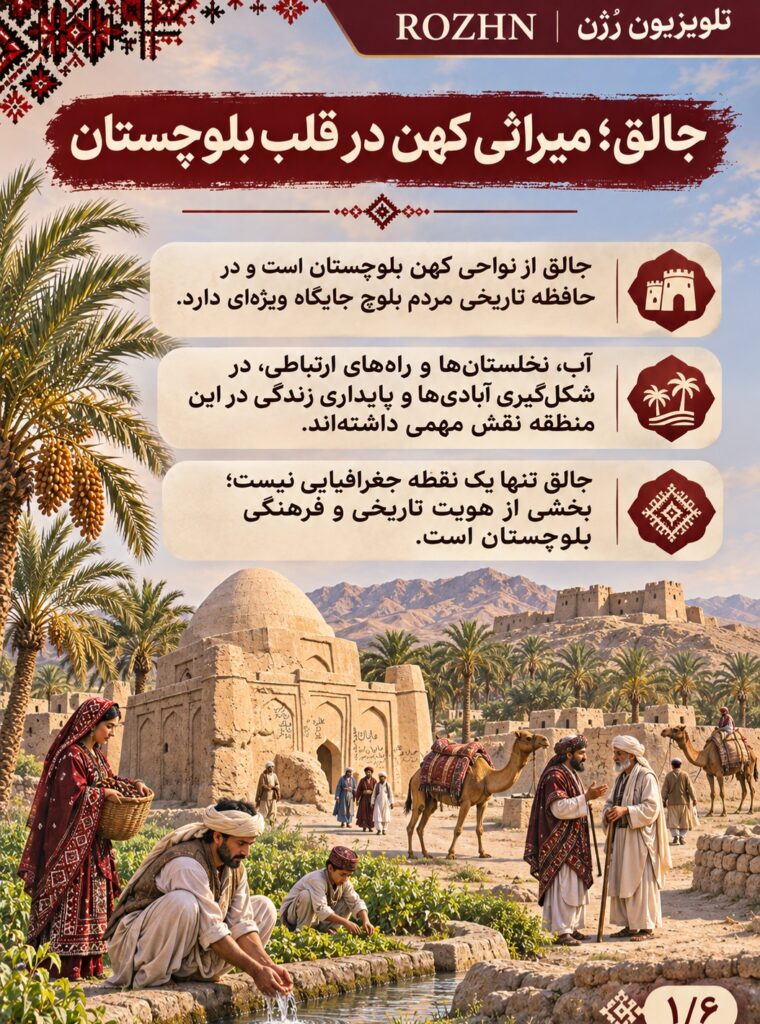
This report was compiled based on a text prepared for Rozhn TV. The dating of some parts of the fort, the attribution of the structure to the Portuguese, and details of local rule require further investigation. The images in the series are artistic and educational reconstructions, not visual documents of historical events.