BalochistanLong read
Jaleq: A Town of Forts, Palm Groves and Ancient History in Balochistan
Rozhn TV | Wednesday, November 25, 2026
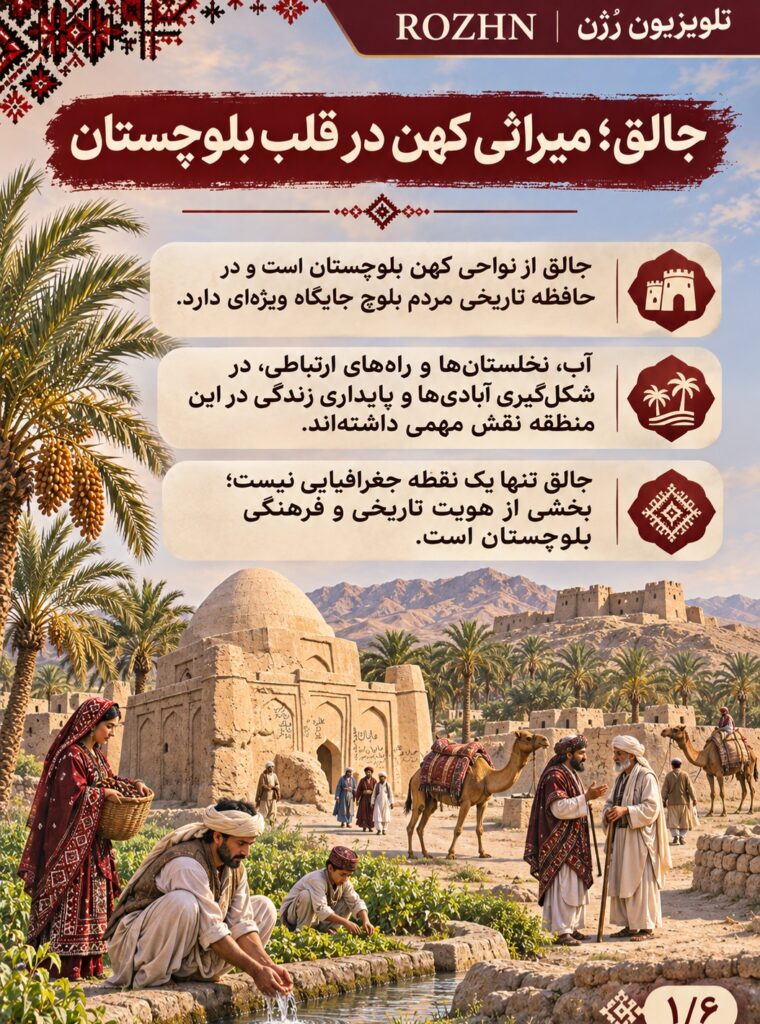
Jaleq, one of the historic towns of Balochistan and the center of Golshan County in southeastern Iran, has a long history of settlement, agriculture, defensive architecture and political change in the region.
The area’s old forts, historic domes, qanats and archaeological remains tell parts of Balochistan’s history that have received little attention in the media and in public sources.
Jaleq in historical sources: a town known for more than a thousand years
One of the most important pieces of historical evidence about Jaleq is a reference by the Muslim geographer al-Muqaddasi in his book “Ahsan al-Taqasim fi Ma’rifat al-Aqalim.”
In the fourth century AH, corresponding to the tenth century CE, al-Muqaddasi mentioned a place called “Jaleq” or “Jalak” in the Makran region.
This source shows that the name Jaleq has appeared in geographical sources for at least more than a thousand years.
There are also local accounts about the name “Golshan” and its connection with Jaleq. Some attribute the change of name to the destruction caused by the Mongol invasion; however, given that the name Jaleq was recorded in sources from before the Mongol period, this account requires further historical research.
The forts of Jaleq: a sign of social structure and local power
One of Jaleq’s distinctive features is its many forts and historic fortifications.
In 19th-century geographical books, Jaleq is described as a cluster of villages, many of which had a fort or defensive tower at their center.
A geographical text dating from 1289 AH (1872-73 CE) also puts the number of forts in the Jaleq area at fifty, although this figure does not reflect the number of structures that survive today.
Historical and local names associated with the forts and neighborhoods of Jaleq include “Amra Fort,” “Dadmohammad Fort,” “Mohammad Karim Fort,” “Mullah Fort,” “Malek Fort,” “Sardar Shirmohammad Fort,” “Shishehriz Fort,” “Sarkuh Fort” and “Kuhkan.”
Some of these names are also recorded in the old divisions of Jaleq’s villages. Nevertheless, the construction dates and current condition of all these forts still require field surveys and archaeological documentation.
The existence of such a collection of names and fortifications shows that an understanding of Jaleq’s history will not be complete without studying local families, the defensive system, water management and the relations between the villages.
Local chiefs and political developments in Jaleq
In various periods, Jaleq and Dezak were important centers of local power in Balochistan.
Nineteenth-century historical documents mention figures such as Mir Alam Khan, Mir Delavar Khan and other local chiefs.
Historical reports indicate that Jaleq had local rule in some periods and that its political relations with Dezak, Kalgan, Kharan and other parts of Balochistan changed over time.
British archival documents also show that in 1902 Iranian government forces entered Jaleq and some of the area’s forts, including Khoshab and Dashtak, were destroyed. The same report states that the Kuhkan and Shishehriz forts were spared from destruction.
A military report by British forces also mentions an operation in Jaleq in 1916 against groups of Gomshadzehis. The document speaks of the siege of a fort and the burning of some settlements.
In addition to recording military events, these documents are important for studying power relations and the lives of the people of Balochistan, although they should be examined with the perspective and aims of their military authors in mind.
Shishehriz and Kuhkan: a rare architectural heritage
Jaleq’s history is not limited to its defensive forts.
The historic tombs of Shishehriz and the domed complex of Kuhkan are considered valuable architectural monuments of the region.
Academic research on the Shishehriz tombs shows that these structures have distinctive dome-building methods, architectural decoration and burial structures.
Architectural studies have linked some features of these structures to the architectural traditions of the Ilkhanid period; however, the exact construction date of all the tombs is not known.
A study published in 2026 also emphasized the architectural importance of eight historic tombs at Shishehriz and the need to document and protect them.
Nahuk and Negaran Valley: pre-Islamic history
Important archaeological remains have also been identified within the historical area of old Jaleq.
The rock carvings of Negaran Valley in the Nahuk area are among the best-known examples, depicting animals, humans and various scenes.
These works show how long human activity and presence in the area go back.
Nevertheless, a distinction should be made between the antiquity of prehistoric remains and the time when today’s ethnic identity took shape. The value of these works lies in understanding the past of the land of Balochistan, not in proving, without documentary evidence, ethnic continuity across all historical periods.
Qanats: the foundation of life and prosperity in Jaleq
Water has been one of the most important factors in the formation of Jaleq’s settlements.
Historical sources mention qanats, palm groves and the cultivation of crops such as wheat, barley, dates and other agricultural products.
Alongside agriculture, animal husbandry and handicrafts such as weaving, mat-weaving and needlework have also been part of the region’s economy and culture.
This background shows that the history of Balochistan is not only a history of wars and forts, but also the history of farmers, craftspeople, women artists and people who developed ways of living and producing in harsh climatic conditions.
Why does understanding Jaleq’s history matter for Balochistan?
Jaleq is an example of the link between local history and the wider history of Balochistan.
From the town’s name in thousand-year-old sources to its defensive fortifications, historic tombs and documents about local rulers, there is a body of evidence that can help to better understand the region’s past.
Protecting Jaleq’s monuments, recording the accounts of elders, documenting the forts and researching historical documents are part of safeguarding Balochistan’s cultural heritage.
The history of Balochistan should not be understood only from the perspective of governments and outside powers; the lives, architecture, local knowledge and narratives of the people of this land are also an inseparable part of this history.
Rozhn TV | History and Culture of Balochistan