The Enforced Disappearance of Baloch Women
The history of enforced disappearances in Balochistan is long, painful and bloody; but today this deadly list has taken on a new and terrifying face: the face of Baloch women. Women who in Baloch culture …
Show photo (≈ 47 KB)
Rozhn TV | Tuesday, December 9, 2025
Aziz Sanghur
The history of enforced disappearances in Balochistan is long, painful and bloody; but today this deadly list has taken on a new and terrifying face: the face of Baloch women. Women who in Baloch culture are regarded as a symbol of respect, honor and dignity; women whom to touch was, in Baloch tradition, an “unforgivable crime” and “unthinkable”, yet today these same women are vanishing in the darkest, nameless cells.
These descriptions are given on the basis of cultural accounts and local testimonies.
On the night of December 8, in the Zahoor Colony area of Dalbandin, a raid by security forces began another chapter of terror. In this operation, the doors of homes were broken down, women and men were terrified, and a sister and brother, Zubair, son of Muhammad Rahim, and Rahima, daughter of Muhammad Rahim, were detained without any legal document and taken to an unknown location.
According to local sources, as of the time of preparing this report no official information has been released about the reason for their detention or where they are being held.
Local sources say there is no registration, case file or official information; total silence, like hundreds of other cases.
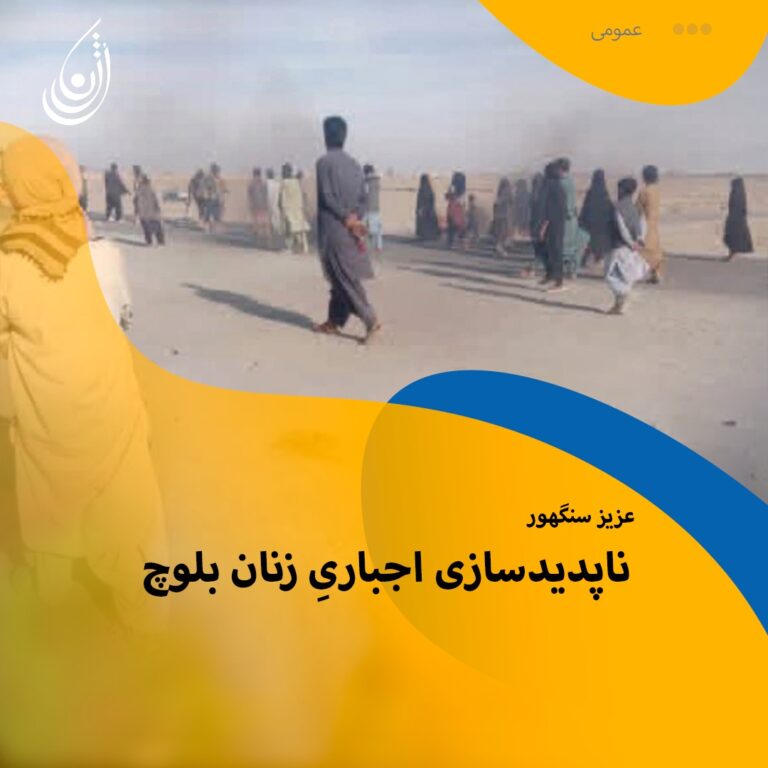
After this heartbreaking incident, the affected family, together with local people, blocked the national highway. A road that echoed for hours with cries for justice. The people had only one demand:
“Release Rahima and Zubair immediately.”
According to field reports, these protests were held peacefully.
But with every passing moment, the shadow of fear and grief grows heavier. Will these two also join the crowd of missing faces? Faces of whom only a name remains, and a mother’s prayer that never reaches its destination.
These questions reflect the concern of families and the local community.
This incident is not the first and, sadly, will not be the last.
On December 1, 2025, Farzana, daughter of Muhammad Bakhsh Zehri, was detained by CTD forces in Khuzdar and disappeared.
According to her family and legal activists, no judicial case or official information about her status has been announced so far.
In Baloch culture, abducting a woman is a historic and moral red line. That is why Farzana has today become a national symbol, a symbol of the shattering of the sanctity of the Baloch woman.
This description is put forward on the basis of cultural and social analyses.
November 22, 2025, was also another terrifying night. State forces raided a house in the Daru Hotel area of Hub Chowki
and abducted Nasreen, daughter of Dilewar Baloch, a fifteen-year-old girl from Tirtej, Awaran, without a warrant, without registration, without any document.
According to family members, as of now no notice or document has been issued by official bodies.
It is as though a child was wiped from the page of life: no voice, no trace, no sign.
But the chain of these disasters is longer than these few names.
On May 29, 2025, from inside the Civil Hospital in Quetta, Mahjabeen Baloch, an active and hopeful student at the University of Balochistan, who had one leg disabled because of polio, was abducted.
Mahjabeen was exposed not only to physical violence but also to structural cruelty. That same month, her brother Muhammad Younis was also abducted. He was later released under pressure from public opinion, but Mahjabeen?
According to her family, she is still missing and no official body has confirmed responsibility for her detention or where she is held.
She is still held between life and death, in a nameless cell.
The Baloch woman has, from the past to the present, been a symbol of “respect”. Even in wars, enmities and tribal feuds, women were an absolute red line. But today that sacred symbol has become the target of a policy that does not strike only at the “body” but aims at the collective and cultural soul of a nation.
These analyses are given on the basis of the views of cultural and legal activists.
This repression is not merely repression;
it is an attack on Baloch culture, identity and honor.
It is the sound of thousand-year-old roots breaking.
This section is the analytical and social interpretation of the author and legal activists.
Dr. Shalee Baloch, head of the Baloch Women Forum, has warned with deep concern that the process of disappearing women has become a “war strategy” of the security institutions. She says:
“These are not just four women; Mahjabeen, Nasreen, Farzana and now Rahima, but an attack on the entire Baloch community.”
She demanded that these women be immediately brought before the judiciary and that the apparatus-driven and violent policies against Baloch women and girls be stopped completely.
She also called on the people of Dalbandin to stand beside Rahima’s family and not let the voice of the demand for justice fall silent.
Today in Balochistan every mother holds her daughters tighter; every father stares anxiously at the door of the house; and every family asks itself:
“Who is next?”
This section reflects the psychological atmosphere and social anxiety.
Rahima, Farzana, Nasreen, Mahjabeen –
These are not just four names,
but four cries
that strike the sky of Balochistan with all their strength,
but in a land where justice is silent,
no door opens to them.
Translated from the Persian original
Follow Rozhn TV for reports, interviews and programmes on Balochistan
Telegram: https://t.me/rozhn_tv
YouTube: https://youtube.com/@rozhn_tv
Instagram: https://www.instagram.com/rozhn_tv
#Arrest #Awaran #Baloch Women #Balochistan, Pakistan #Enforced disappearance #Khuzdar #Quetta