نواب خیربخش مری؛ روشنفکری که اندیشهاش زنده است
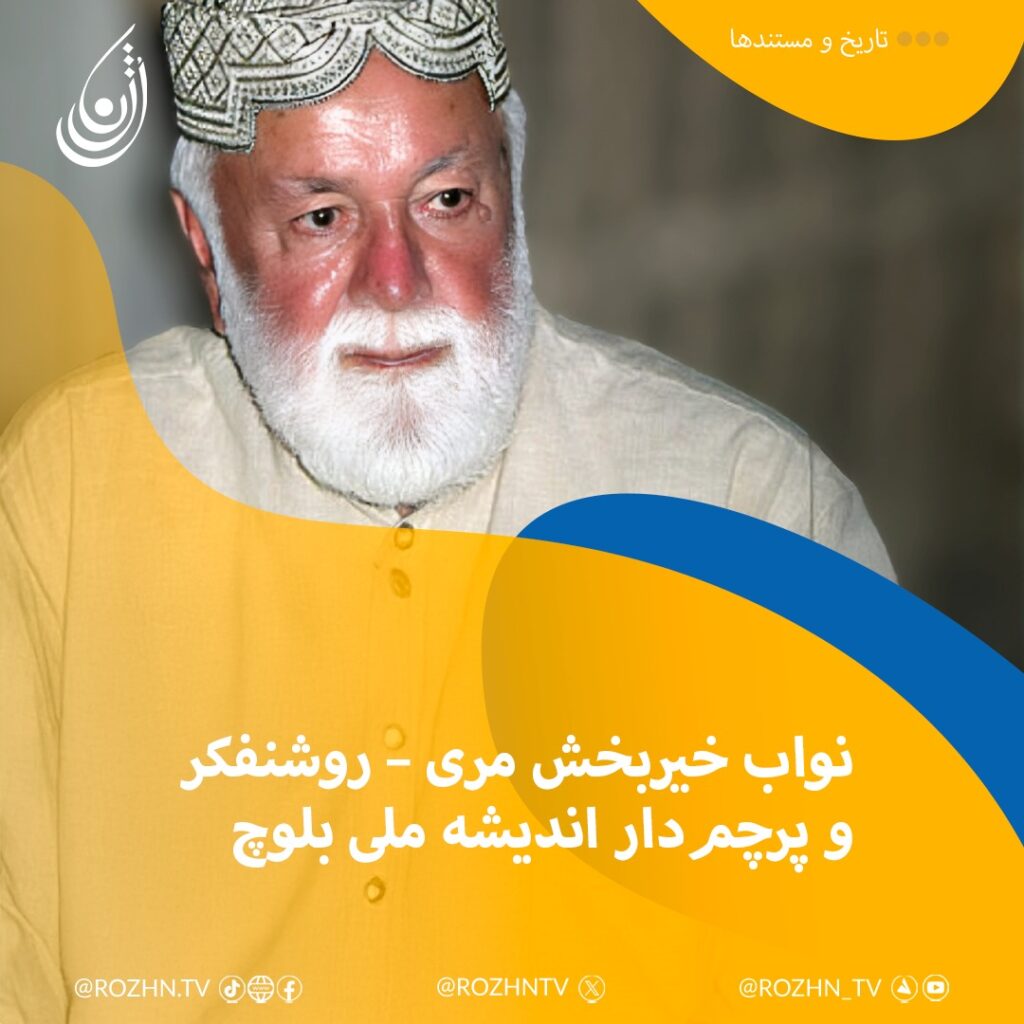
ENNawab Khair Bakhsh Marri: An Intellectual Whose Thought Lives OnRead in English
Karachi – Rozhn TV | Tuesday, June 10, 2025
Today, the anniversary of the death of Nawab Khair Bakhsh Marri, an enduring figure of the Baloch nationalist movement, was marked with respect and remembrance across Balochistan and among Baloch diaspora communities. Nawab Marri is regarded not only as a political leader but as a symbol of an intellectual, identity-based and resistance movement for the Baloch people.
A Legacy Beyond Politics
Nawab Marri was born in 1928 in Kohlu, Balochistan, and completed his education at Aitchison College in Lahore. It was there that he became acquainted with ideas of justice and ethnic rights and began his political life. In the 1960s, when the extraction of natural resources from Marri land began, his voice of protest against exploitation and discrimination was raised.
Resistance and Parliament
Nawab Marri entered Pakistan’s National Assembly in 1970, but because of what he called “disregard for the demands of the Baloch people,” he did not accept the 1973 Constitution. From 1973 to 1977, he played a key role in political and armed resistance against the central government and was a staunch defender of the right to provincial autonomy.
Years of Exile and Theorizing
Following the ban on the National Awami Party (NAP), Nawab Marri went into exile in Europe and Afghanistan and spent years on study, writing and political education of the young Baloch generation. The founding of the “Haq Tawar” study circle in 1992 was part of his effort to develop the ideological discourse of Baloch nationalism.
He repeatedly stressed:
“Weapons alone are not enough; true freedom requires an ideology.”
Principled to the End
Even during his imprisonment in the Justice Nawaz Marri case in the 2000s (the 1380s in the Iranian calendar), he did not back down from his positions. His famous statement that “the resources of Balochistan belong only to the people of Balochistan” became a slogan for many activists.
The Respect of Generations
The anniversary of his death is commemorated every year in places such as Lyari, Turbat, Panjgur, Kabul, Muscat and Cologne with candle-lighting, speeches and cultural marches.
Dr. Naseem Baloch, one of the new intellectual figures of the Baloch, says of him:
“Nawab Marri is a symbol of struggle, sacrifice and ideological steadfastness; a figure who went beyond politics and became a symbol of identity.”