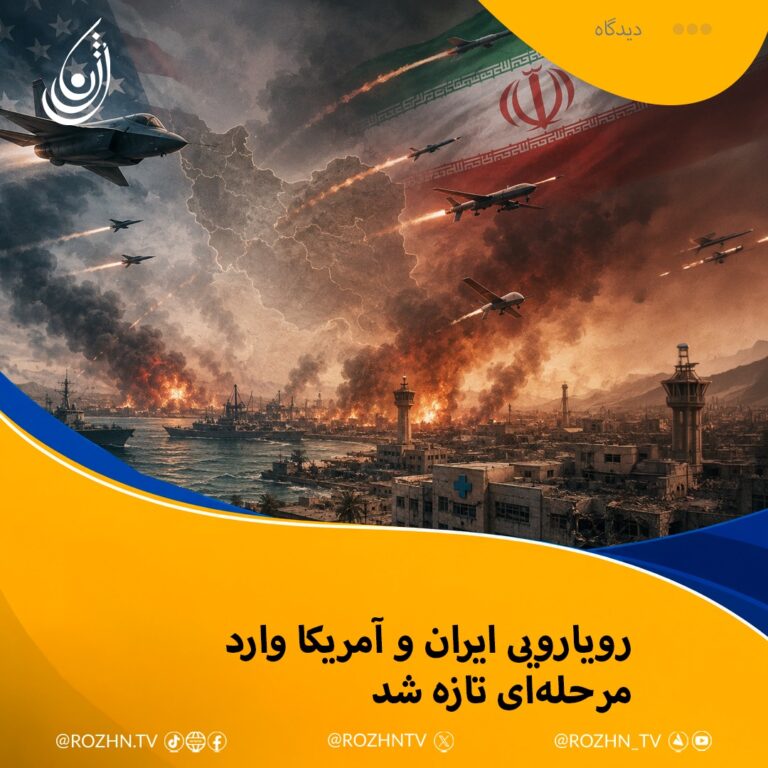
Iran–US Confrontation Enters a New Phase
The continuing military clashes between the United States and the Islamic Republic of Iran show that this crisis is no longer confined to Iran’s borders but is tied to the security of the Persian Gulf, …
Show photo (≈ 93 KB)
Rozhn TV | Saturday, July 18, 2026
Rozhn TV Viewpoint
The continuing military clashes between the United States and the Islamic Republic of Iran show that this crisis is no longer confined to Iran’s borders but is tied to the security of the Persian Gulf, the Sea of Oman, the Strait of Hormuz and the region’s strategic sea lanes.
In recent weeks, American officials have repeatedly warned Tehran to stop attacks on US forces and interests and to take the path of de-escalation and negotiation. Washington has also warned that if the attacks continue, a harsher military response awaits the Islamic Republic.
Despite these warnings, the Islamic Republic has in several rounds targeted, with missiles and drones, bases and facilities used by American forces in countries of the region, including Kuwait, Bahrain, Jordan and other Persian Gulf states. Tehran describes these operations as a response to American attacks, but the continuation of these attacks has widened the scope of the conflict and drawn more countries into the crisis.
American officials have said their military operations are aimed at protecting US forces and interests, countering maritime threats, preserving freedom of passage in the Strait of Hormuz, and reducing the Islamic Republic’s military capability. According to Washington, Tehran’s attacks on American bases, allied countries and shipping routes have been one of the main factors behind the continuation and escalation of military operations.
In contrast, the Islamic Republic has described the American attacks as a violation of Iran’s sovereignty and has said its military actions against American targets in the region are carried out within the framework of defense and reciprocal response.
Nevertheless, Tehran’s continued attacks on bases located in Persian Gulf countries have increased the risk of the war spreading. These attacks endanger not only American forces but also the security of the host countries, vital infrastructure and the region’s citizens, and could push Gulf governments further toward military cooperation with Washington.
Under these circumstances, Balochistan has in recent days become one of the most important arenas of this confrontation. Published reports indicate attacks and explosions in Chabahar, Konarak, Iranshahr, Bampur, Jask and a number of other areas in southern and southeastern Iran, areas where, in some cases, the Islamic Republic’s bases, airports, maritime facilities and military centers are located close to cities and to citizens’ homes.
In Bampur, reports have been published of a military center being targeted, and in Iranshahr, reports have emerged that the city’s airport was damaged during the clashes. Local officials have announced the death of Khaled Ghaderi, the shift supervisor at the meteorological building of Iranshahr airport.
In Chabahar and Konarak as well, citizens have reported hearing several explosions. The Islamic Republic’s official media have reported that parts of the port facilities, the maritime traffic control tower and power transmission lines were damaged, and that shrapnel struck Imam Ali Hospital.
Unofficial reports have also been published of the Imam Ali naval base of the IRGC Navy in Chabahar being targeted. This part of the reports has so far not been independently confirmed, and American officials have not released full details about all the targets of the operation.
Along the coast of southern Iran, explosions have also been reported in Jask, Sirik, Bandar Abbas, Qeshm Island, Abu Musa and other areas. Iranian media have announced that air defense systems in some coastal areas engaged attacking targets, and the sound of several explosions was heard in Bandar Abbas and its surroundings.
For the Baloch people, the issue is not only the location of military bases or the targets announced by the warring parties. Their main concern is the consequences of the continuation of this crisis for citizens’ lives, the power grid, hospitals, ports, roads, communications and daily life.
Balochistan has for years faced poverty, unemployment, a shortage of medical facilities, weak infrastructure, a fuel crisis and widespread economic problems. Damage to the power grid, medical centers, transport links and port facilities could put further pressure on families who were already living in difficult conditions before this conflict began.
The continuation of fighting in areas where military centers and residential areas lie in close proximity increases the risk of harm to civilians. Under the principles of humanitarian law, all parties to the conflict are obliged to distinguish between military and civilian targets and to take the necessary measures to prevent harm to people and vital infrastructure.
What has happened in recent days shows that Tehran’s decision to continue attacking American bases and regional targets could bring more military pressure on Iran and expose border and deprived regions such as Balochistan to wider consequences.
At the same time, the United States has said that if Iran halts its attacks and Tehran returns to the path of negotiation, there is a possibility of scaling back military operations, but the continuation of the Islamic Republic’s missile and drone attacks could increase the likelihood of harsher responses and a wider war.
If this situation continues, it could affect the security of the Persian Gulf and the Sea of Oman, maritime trade, the regional economy and the lives of millions of citizens even more. The responsibility for preventing the spread of the war lies with all parties, but the continuation of Tehran’s attacks on American bases and on countries of the region plays an important role in intensifying the crisis and increasing the likelihood of further military reactions.
Translated from the Persian original
Follow Rozhn TV for reports, interviews and programmes on Balochistan
Telegram: https://t.me/rozhn_tv
YouTube: https://youtube.com/@rozhn_tv
Instagram: https://www.instagram.com/rozhn_tv
#Bampur #Chabahar #Imam Ali Hospital #Iranshahr #Islamic Republic #Persian Gulf #Rozhn TV #United States