Balochistan Shines on the World Cinema Screen: Majid Majidi’s “Midday Meal” Wins Best Film at Busan Festival
The feature film “Midday Meal,” directed by the well-known Iranian filmmaker Majid Majidi, whose story is set in the Balochistan region and was filmed in Chabahar, has won the award for best film at the …
Show photo (≈ 100 KB)
Rozhn TV | Thursday, October 15, 2026
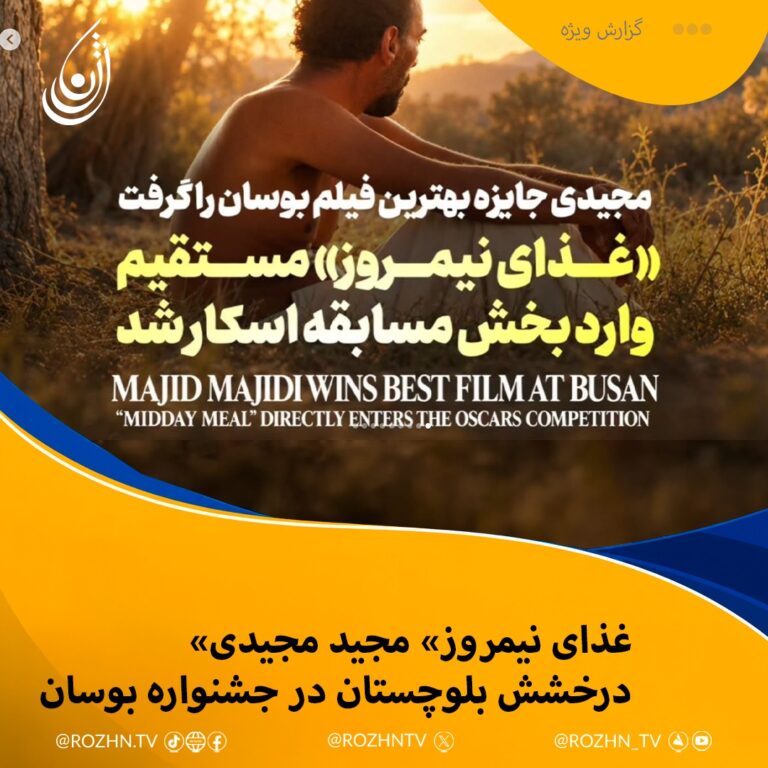
The feature film “Midday Meal,” directed by the well-known Iranian filmmaker Majid Majidi, whose story is set in the Balochistan region and was filmed in Chabahar, has won the award for best film at the 31st Busan International Film Festival in South Korea.
According to the culture desk, “Midday Meal,” Majid Majidi’s latest work, won the most important award in the festival’s competition section at the closing ceremony of the Busan International Film Festival on Thursday, October 15, 2026.
The festival’s seven-member jury, headed by the renowned Chinese director Zhang Yimou, unanimously chose the film as best film. This success has also paved the way for the film to be considered for competition in the Best International Feature Film category at the Academy Awards.
The Story of a Teacher in Balochistan
“Midday Meal” tells the story of a teacher named Solan who teaches in a deprived and remote village in the Chabahar region. Despite his meager income and the hardships of his life, he strives to keep the village children’s education going while also building a better future for himself and his mother.
But with the death of a benefactor who paid for the students’ meals, the school falls into crisis. Many of the children, for whom the school meal covers an important part of their daily needs, are on the verge of dropping out.
To keep the school from closing, Solan is forced to make difficult decisions, decisions that gradually affect his personal life, his professional standing and his moral beliefs.
In the film, Mohammad Rahimi plays the lead role, and alongside educational issues the story deals with themes such as poverty, social responsibility, lack of facilities and the difficulty of human choices.
Majid Majidi’s Return to Balochistan After More Than Three Decades
Majid Majidi is one of the best-known figures of Iranian cinema on the international stage. With works such as “Children of Heaven,” “The Color of Paradise,” “Baran” and “The Song of Sparrows,” he has earned a special place in socially engaged and humanist cinema.
In 1999, “Children of Heaven” was nominated for the Academy Award for Best Foreign Language Film, bringing Majidi’s name even more prominently to world cinema.
However, Majidi’s cinematic connection with Balochistan goes back many years.
In 1992 he made his first feature film, “Baduk,” about the smuggling and exploitation of children in the Sistan and Baluchestan region. The work was also screened in the Directors’ Fortnight section of the Cannes Film Festival.
Now, 34 years later, Majidi has returned to Balochistan with “Midday Meal”; a region whose children’s lives, social inequalities and livelihood hardships had earlier inspired one of the important works of the beginning of his filmmaking career.
Balochistan: More Than a Geographical Location
The choice of Balochistan as the setting of “Midday Meal” carries particular cultural and social significance.
Balochistan is a land with a historical past, a rich culture, language, music and ancient traditions; yet in many media narratives, the image of the region has been largely tied to economic deprivation, border issues and social problems.
The presence of a film by a well-known director at a prestigious festival can be an opportunity to draw the attention of a global audience to the lives of the people of this region.
Nevertheless, showing social hardship is only one dimension of understanding Balochistan. Addressing the culture, identity, everyday experiences, hopes and capabilities of the Baloch people can also offer a fuller and more humane picture of this land.
From this perspective, the success of “Midday Meal,” beyond its cinematic importance, raises an important question: how can films be made about the lives of people in less-seen regions without their identity and cultural diversity being overshadowed by economic problems?
International Critics’ Reception
The screening of “Midday Meal” at the Busan festival drew the attention of critics at international film media.
Reputable film publications including Variety, Screen International and The Film Verdict, in their reviews, have addressed Mohammad Rahimi’s performance, Majidi’s narrative approach and the portrayal of the lead character’s moral struggles.
The cinematography by Houman Behmanesh has also been among the aspects noted by critics, particularly in depicting the dry, vast landscapes of the Chabahar region and linking them to the characters’ living conditions.
“Midday Meal” is a 2026 production with a running time of 133 minutes and is considered a production of the Institute for the Intellectual Development of Children and Young Adults (Kanoon).
An Opportunity for Balochistan’s Stories to Be Seen
The success of “Midday Meal” at the Busan festival shows that local narratives and stories drawn from the lives of people in regions far from the main centers of film production can also attract the attention of international audiences and juries.
At the same time, this success could lay the ground for fresh conversations about the need for a greater presence of native Baloch filmmakers in cinema; artists who, with direct knowledge of the region’s language, culture and social realities, are able to tell Balochistan’s stories from the perspective of its own people.
“Midday Meal” has once again linked the name of Balochistan with one of the most important cinema events in Asia; a land with many untold stories, whose capacity to be present in world cinema goes far beyond a single film or a single festival.
Translated from the Persian original
Follow Rozhn TV for reports, interviews and programmes on Balochistan
Telegram: https://t.me/rozhn_tv
YouTube: https://youtube.com/@rozhn_tv
Instagram: https://www.instagram.com/rozhn_tv