The Abduction of Girls in Balochistan
In Balochistan, it is no longer only leaving the house that offers girls no guarantee of safety; even staying at home does not. Sometimes students are abducted, sometimes political activists disappear, and now students at …
Show photo (≈ 78 KB)
Rozhn TV | Friday, October 16, 2026
By Aziz Sanghur
In Balochistan, it is no longer only leaving the house that offers girls no guarantee of safety; even staying at home does not. Sometimes students are abducted, sometimes political activists disappear, and now students at the FSc (higher-secondary) level, young girls, housewives and women who raise their voices for human rights have also become exposed to alleged enforced disappearances. The question is: where do the law, the constitution and the claims about ensuring the safety of women and girls in Balochistan stand? Can the parents of a girl in this region be confident that their daughter will sleep at home at night and still be with them in the morning?
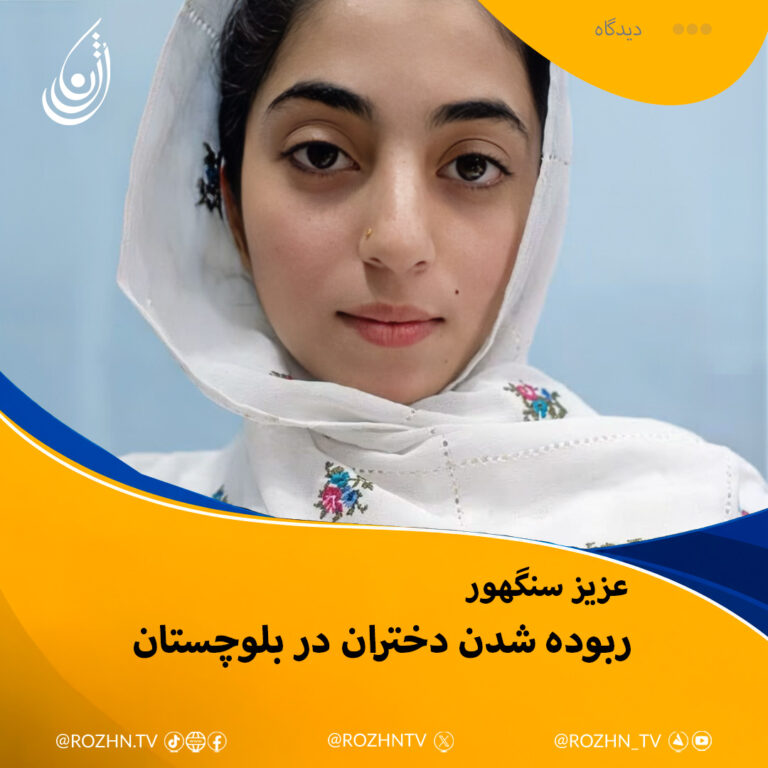
The alleged disappearance of Laiba Sattar, a 19-year-old student from Kalat, has raised this question once again with full force. According to the Baloch Yakjehti Committee (BYC), Laiba Sattar, the daughter of Abdul Sattar, is an FSc student who disappeared from Kalat at around 9 p.m. on the night of March 29, 2026. The organization has pointed to groups known as “death squads” in connection with her disappearance.
The most serious aspect of Laiba’s disappearance is that she is a student, and the main purpose of her life should be to study and build a future for herself. But if the safety of even a young student cannot be guaranteed, all claims about education, development and a bright future become meaningless. The most basic question for her parents will be: where is their daughter? What condition is she in? And if an institution or group has taken her into its custody, why has she not been brought before a court?
Laiba Sattar’s case is not an isolated incident. Other such cases include Mahjabeen Baloch, 15-year-old Nasreen, Ayesha Baloch, Shakila Baloch, Gul Banuk, Haseena Baloch, Zubaida, Zarnaz Baloch and Habiba Pirjan, a Balochi-language poet. In addition, the disappearance of a 65-year-old woman from Dera Bugti was also reported; she was identified as the wife of Shahal Mamdazi Bugti.
In August, news emerged of the disappearance of Safia Baloch. Similarly, in June the Baloch Yakjehti Committee raised the alleged disappearance of Rizwana, a 16-year-old student from Quetta. These incidents show that the safety of women and students remains an unresolved issue.
Over the past years, the term “death squads” has become an important part of political and human rights discourse in Balochistan. Human rights activists and affected families have repeatedly accused armed groups of targeting citizens, political activists and people perceived to be linked to the resistance. These groups enjoy state backing.
In Laiba Sattar’s case, too, the fundamental question is the same: where is she, and who is responsible for her disappearance? If a group has abducted her, it must be held accountable before the law. If a state institution has information about her, it must share that information with her family. And if she has been detained on a charge, she must be brought before a court in accordance with the law. Holding a citizen in an unknown location, keeping her family in the dark and failing to clarify her legal status is an approach that raises serious questions about justice and the rule of law.
The unlawful abduction of a woman or girl because of an accusation against her father, brother, husband or another relative is in no way acceptable. The concept of collective punishment runs counter to the fundamental principles of justice. An accusation against one member of a family cannot justify punishing the entire family.
Women in Balochistan who raise their voices against enforced disappearances already face severe social, economic and psychological pressure. If students and young girls are now also exposed to this fear, the consequences will not be confined to the affected families. The fear will spread through schools, homes and society as a whole. Parents will become anxious and uncertain about their daughters’ education, movements and future.
Laiba Sattar’s parents, too, have the right to know the truth about their daughter. If she has committed no crime, she must be released immediately and returned to her family, and if there is a charge against her, she must be dealt with in accordance with the law. Keeping her family in the dark indefinitely is no solution to any problem.
The names of Balochistan’s daughters have now become a question: Mahjabeen, Nasreen, Ayesha, Shakila, Gul Banuk, Haseena, Zubaida, Zarnaz, Habiba, Safia, Rizwana and now Laiba Sattar. Each of these names represents a separate family, a different dream and a future of its own. The current status of each of them must be confirmed and clarified, and the outcome of every case must be made transparently public, so that none of these names is treated as just another news item and consigned to oblivion.
In the end, the question is not only where Laiba Sattar is. The question is: who will guarantee a girl’s safety in Balochistan? If the law cannot protect a student, if access to the courts is not guaranteed and if parents cannot even obtain information about their daughter, then what do claims of justice mean? The recovery of Laiba Sattar, answers for her family and the prosecution of those responsible are no longer merely a demand; they are a fundamental necessity for justice to be served.
Translated from the Persian original
Follow Rozhn TV for reports, interviews and programmes on Balochistan
Telegram: https://t.me/rozhn_tv
YouTube: https://youtube.com/@rozhn_tv
Instagram: https://www.instagram.com/rozhn_tv