The Camel: A Heritage Millions of Years Old and a Symbol of Life in Arid Lands
The camel is not merely a beast of burden; it is one of the most remarkable examples of how living creatures adapt to the Earth's harshest environments. The evolutionary history of the camel family dates …
Show photo (≈ 189 KB)
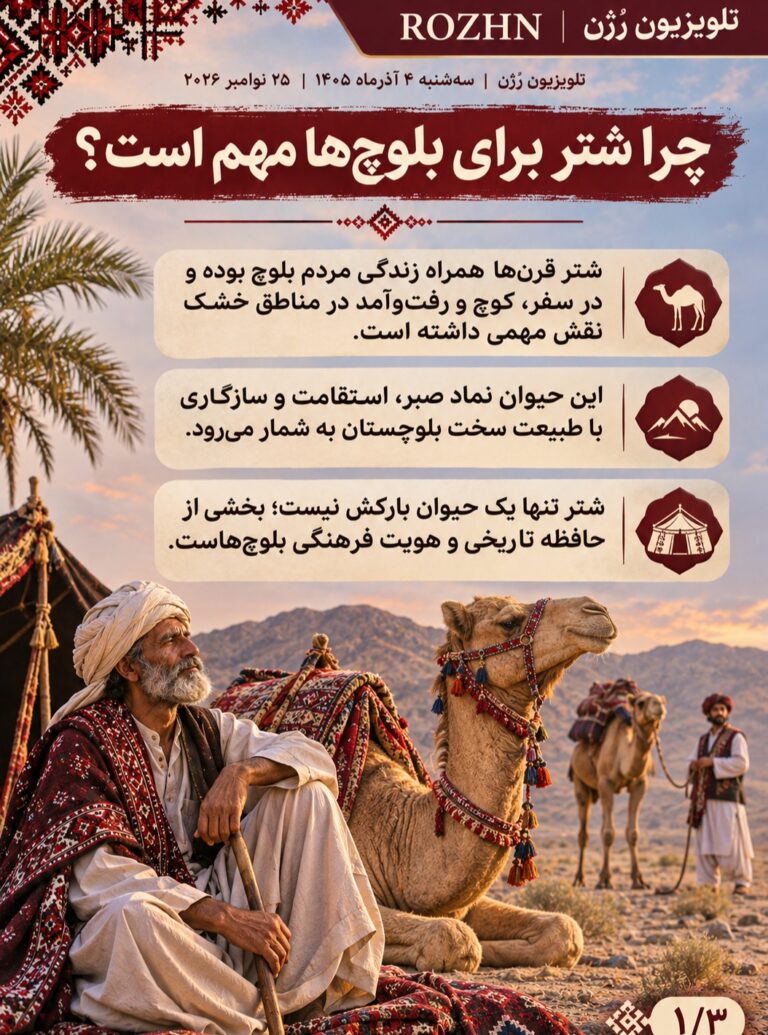
Rozhn TV | Tuesday, November 24, 2026
The camel is not merely a beast of burden; it is one of the most remarkable examples of how living creatures adapt to the Earth's harshest environments. The evolutionary history of the camel family dates back millions of years, and their ancestors first appeared in North America.
From a biological perspective, the camel has a set of unique traits: the ability to tolerate water scarcity, reduced water loss, broad feet for moving across sand, and fat stored in its hump. Contrary to popular belief, the camel's hump does not store water; it is a reserve of fat that supplies energy.
Humans domesticated the camel thousands of years ago, and the animal became one of the most important companions of communities living in the arid regions of Asia and Africa. Besides transport and trade, the camel has been a source of milk, meat and fiber, and has helped sustain livelihoods in environments where raising many other kinds of livestock is difficult.
But why has the camel survived after millions of years?
From a scientific point of view, the answer lies in evolution and natural selection. Traits that increased the chances of survival and reproduction under harsh conditions have been preserved over successive generations. Domestication has also helped the camel spread and has sustained its domesticated populations.
In Baloch culture, the camel holds a place beyond its economic value. For past generations, the animal was a companion in travel, migration, trade and daily life, and in the cultural memory of Balochistan it is associated with patience, endurance and harmony with nature.
The true value of the camel should be understood in three dimensions: its biological and evolutionary value, its economic and livelihood importance, and its historical and cultural place.
Understanding and protecting this animal is not only about honoring an old tradition; it is also part of caring for biodiversity, sustainable livelihoods and the future of the world's arid lands.
Translated from the Persian original
Follow Rozhn TV for reports, interviews and programmes on Balochistan
Telegram: https://t.me/rozhn_tv
YouTube: https://youtube.com/@rozhn_tv
Instagram: https://www.instagram.com/rozhn_tv