
بلوچستان · ویدیو
ملک دینار و گاندوها؛ افسانهای زنده در قلب بلوچستان
ENMalek Dinar and the Gandos; a Living Legend in the Heart of BalochistanRead in English
Sarbaz River, Sarbaz County – Saturday, May 17, 2025
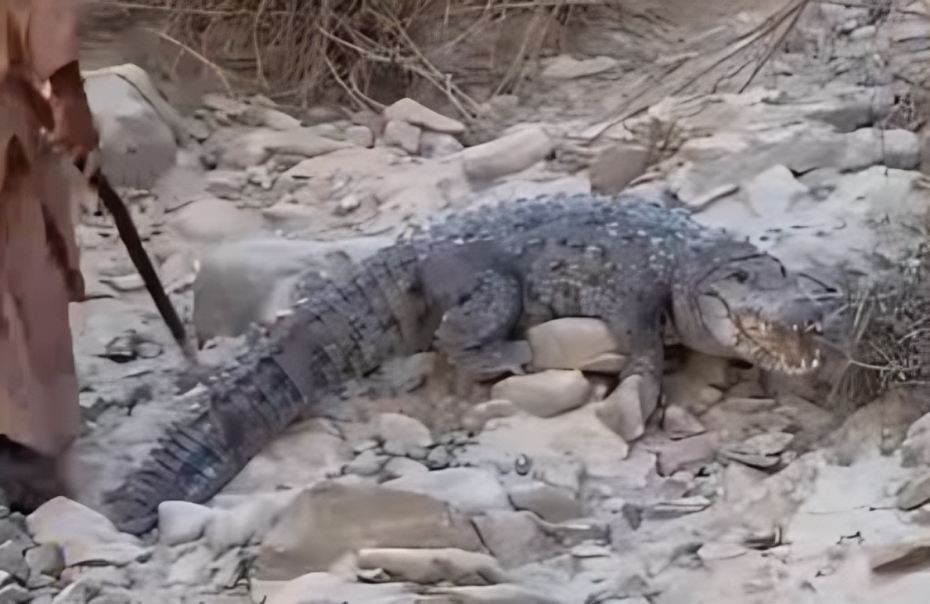
In southeastern Iran, somewhere between the scorching hills and the low-water rivers of Balochistan, lives an animal whose lineage goes back to the age of the dinosaurs: the gando, or Iranian mugger crocodile. This native reptile, the only crocodile species in Iran, is scattered along the Sarbaz, Bahukalat and Keshik rivers. But its survival, like that of its homeland, is under serious threat.
The last stronghold of survival
In recent years, severe droughts, falling river levels, habitat destruction and the negligence of responsible bodies have put the gandos at risk of extinction. The Sarbaz River, one of the gando’s last refuges, with its dropping water level and shrinking natural prey, is no longer a safe environment for this valuable reptile.
Amid all this, one familiar and respected name is heard among Sarbaz’s natives and environmental activists: Malek Dinar Shajari. A man who for more than two decades has voluntarily taken food to the gandos every day, looked after their nests, and quietly worked to ensure their survival.
A man with a silent mission
Malek Dinar is a simple-living elderly man native to the area who has devoted his life to saving the gandos. He says:
“The gando is silent, just like us Baloch, but when threatened it defends itself. If we do not protect it, this rare animal will be wiped out too.”
This lone man, with no official support, on a meager income and on some days even going hungry himself, prepares fish or chicken for the gandos and leaves it beside the nests or in shallow pools. In the punishing heat, in the heart of the silence of mountain and water, his voice is familiar only to the animals. Many of the area’s natives say the crocodiles know him and do not flee at the sight of him.
A symbol of indigenous resistance against oblivion
At a time when many development projects on the Makran coast and in the southern rivers are carried out without regard for the region’s ecosystem, Malek Dinar’s effort has become a symbol of coexistence, conservation and unconditional love for nature. Independent environmental organizations in Balochistan have repeatedly called on government bodies to support people like him, but so far these local voices have received almost no attention.
Despite the gando’s importance to biodiversity in Iran and the region, there is no precise figure for its current population. Independent experts estimate that fewer than 400 gandos remain in the whole of Iranian Balochistan, a number that will decline if the current trend continues.
An uncertain future?
Although Malek Dinar’s story is admirable, it is not enough. Without systematic support, the conservation of species like the gando cannot be sustained by the efforts of men like him alone. In recent years Malek Dinar has been struggling with illness, old age and hardship of livelihood, yet he is still unwilling to step aside from his path.
In his most recent local interview, he said:
“As long as I am alive, I will keep visiting these animals. They too are part of the soil of Balochistan, like me, like you.”
A post shared by Rozhn TV (@rozhn_tv)



