The Poet Whose Name Is Tied to Balochistan’s Cultural History
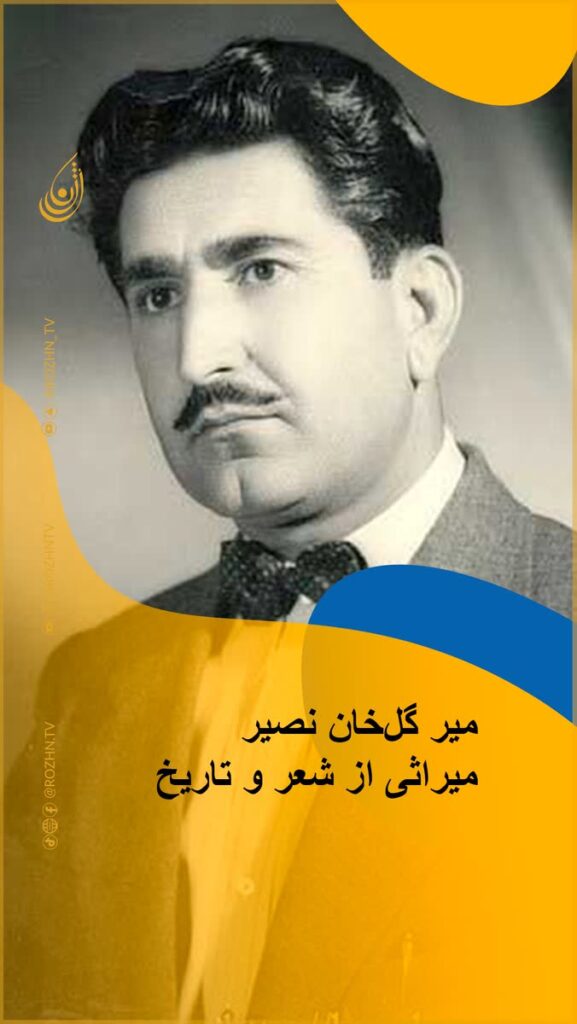
Mir Gul Khan Nasir was one of the best-known literary and political figures of Balochistan, whose name is tied to poetry, cultural identity and social activism in Balochistan’s contemporary history He was born in Nushki …
Rozhn TV | Monday, May 25, 2026
Mir Gul Khan Nasir was one of the best-known literary and political figures of Balochistan, whose name is tied to poetry, cultural identity and social activism in Balochistan’s contemporary history
He was born in Nushki in 1914 and grew up in a period when Balochistan was under complex political structures and the influence of British rule. From his young years Mir Gul Khan Nasir showed an interest in education, literature and social activism, and after continuing his studies in Quetta and Lahore he became familiar with the literary and political currents of his time
Alongside his cultural activities, Mir Gul Khan Nasir was also present in politics and took part in several Baloch and nationwide political organizations. He was arrested many times because of his political activities and speeches and spent a significant part of his life in prison
Many scholars of Baloch literature regard him as one of the most influential contemporary poets of the Balochi language. His poems were mostly about poverty, social justice, the condition of ordinary people, Baloch culture and human issues, and for this reason he became known among different generations
Mir Gul Khan Nasir wrote in Balochi, Persian, Urdu and English, but his Balochi works achieved the greatest fame. The collection “Gulbang” is considered one of his best-known works and holds a special place in the history of Balochi literature
He died in 1983 after a period of illness and was buried in his birthplace. Years later the Pakistani government posthumously awarded him the “Sitara-e-Imtiaz” medal
Today the name of Mir Gul Khan Nasir remains well known among enthusiasts of Baloch culture and literature as a poet, writer and influential figure in Balochistan’s contemporary history