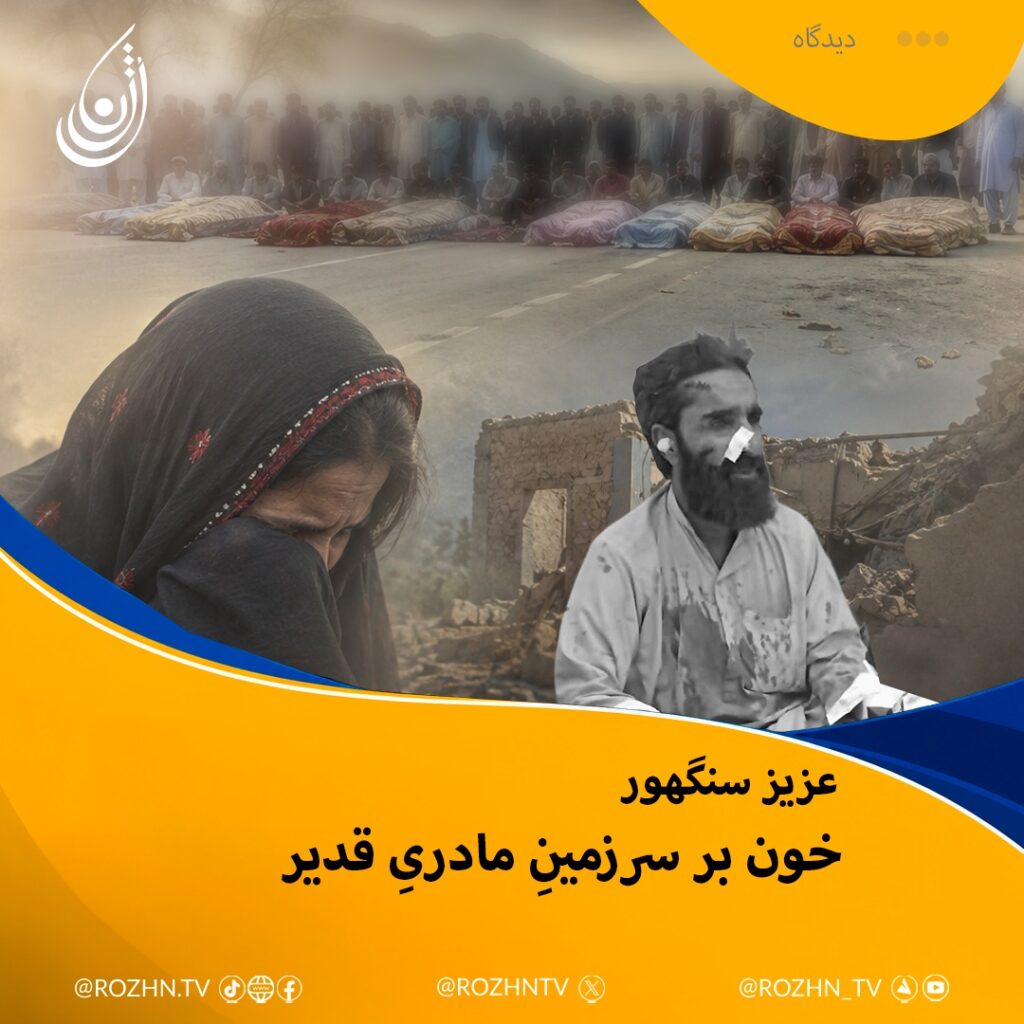
Blood on Qadir’s Motherland
According to local reports, what has been described as an aerial bombardment last night in the Gedar area, at the Gondan site in Surab County, Balochistan, has once again put Balochistan’s human tragedy in the …
Rozhn TV | Wednesday, August 12, 2026
Guest Column | Aziz Sanghur
According to local reports, what has been described as an aerial bombardment last night in the Gedar area, at the Gondan site in Surab County, Balochistan, has once again put Balochistan’s human tragedy in the spotlight. According to the same reports, more than twenty people were killed and many others wounded in what was described as bombing by fighter jets.
The most worrying aspect of such incidents is that there are reports of restricted access for independent media, human rights bodies and impartial observers to the affected areas; for this reason, it takes time to clarify the true scale of the incident and establish the exact number of victims.
After what local sources described as an aerial operation in Gedar-e Gondan in Surab, the situation became more critical when the victims’ families placed the bodies of their loved ones in the main square of Surab and on the Quetta–Karachi national highway, N-25, and began a sit-in and protest.
Placing the bodies of loved ones on a road is not an easy decision for any family. This is a moment when a father beside his child’s body, a mother beside her beloved son, a sister beside her brother and a wife beside her husband’s body cry out for justice.
The demands of the protesting families are not limited to officials investigating the deaths of their loved ones; they want to know what their loved ones’ crime was and why they lost their lives. If these people were ordinary citizens, who bears responsibility for the loss of their lives?
The human rights issue in Balochistan is not new. For decades this region has struggled with political unrest, reports of enforced disappearances, security operations, insecurity and poverty. In such circumstances, every new death deepens an old wound. The biggest complaint of people in Balochistan’s remote areas is that their voice does not reach the national level as it should.
Here the role of Pakistan’s media also takes on special importance. A free press in any country does not mean merely broadcasting government statements. The real test of journalism comes when asking questions is difficult. When a major human tragedy occurs in Balochistan, the national media must also reflect the voices of the affected people, publish the views of the government and security institutions, and at the same time clarify the contradictions among the different accounts.